Pros: Atrium: – might just have the best vocal and acoustic instrument timbre I have heard
– engaging, ‘analogue’ sound
Verité: – balanced, dynamic sound with unique wood reverbs
– exceptional pairing with (OTL) tube amplifiers
Caldera: – TOTL planar technicalities with organic ZMF flavour
Cons: Atrium: – not the last word in bass and treble detail/clarity
– bass elevation could be too much for some
Verité: – stage lacks a bit of depth
– performance is more amplifier dependent
Caldera: – doesn’t quite have the acoustic body of the dynamic ZMF headphones
Disclaimer & Intro
As a fan of good planar headphones and the owner of a gorgeous Caldera Open, reviewing the Bokeh Open back in February took me by surprise and reignited my interest in dynamic driver headphones. I really enjoyed the energetic, dynamic character and lively midrange presentation of the Bokeh Open.
I had auditioned the Atrium and Verité several times on various amplifiers, but never had them at home for an extended period. When Zach (Zach Mehrbach, owner and mastermind behind ZMF) offered the pre-production Ori 3.0 for review, I asked if it would be possible to include the Verité and Atrium as well, in order to get the full picture of what these headphones can really do. I am not affiliated with ZMF, and the demo units will soon be heading back to the USA. As always, you can expect only my honest findings.

Beautiful craftmanship.
Since all of these headphones have been out for a while and covered many times, this review will take a more unconventional approach — slightly different from the regular structure I normally follow. Instead of going into build quality and comfort details on the Atrium that you’ve already heard multiple times, I’ll purely focus on the sonic similarities and differences between these three wonderful ZMF headphones to help potential buyers understand them better and hopefully make purchase decisions easier.
I recently reviewed the brand-new ZMF Ori 3.0, and that write-up includes direct comparisons to the three headphones discussed here. So, if you’d like to find out where the Ori 3.0 stands in relation to these open-back models, click here. Likewise, if you’re interested in my impressions on the Caldera Closed, you can read that review here.
A bit of history and some tech details on these three headphones
Believe it or not, the Verité open was released seven years ago, at the end of 2018. I feel that since then it has taken a back seat and somewhat got forgotten in the shadow of newer ZMF releases. In my opinion, the Verité is still 100% relevant today, so I want to pull it back into the spotlight alongside the Atrium and Caldera. In my opinion the Verité is the easiest to misunderstand, as it needs more careful amplifier matching. The Verité was ZMF’s first true flagship with 300Ω impedance and 97dB/mW sensitivity, practically the same specs as of the Atrium open. There are some major differences between the two dynamic drivers and that is the diaphragm material and the patented Atrium damping system (ADS). Verité’s driver is made of polyethylene naphthalate and is coated with vapor-deposited beryllium. This might sound familiar if you know the Focal Utopia, which uses a similar beryllium coating. These types of drivers are often detail focused and bring a higher sense of clarity. The Atrium on the other hand uses biocellulose diaphragms, which might sound familiar from certain Fostex models or the legendary Sony MDR-R10. Biocellulose drivers are known to offer a heightened sense of realism and organic texture.
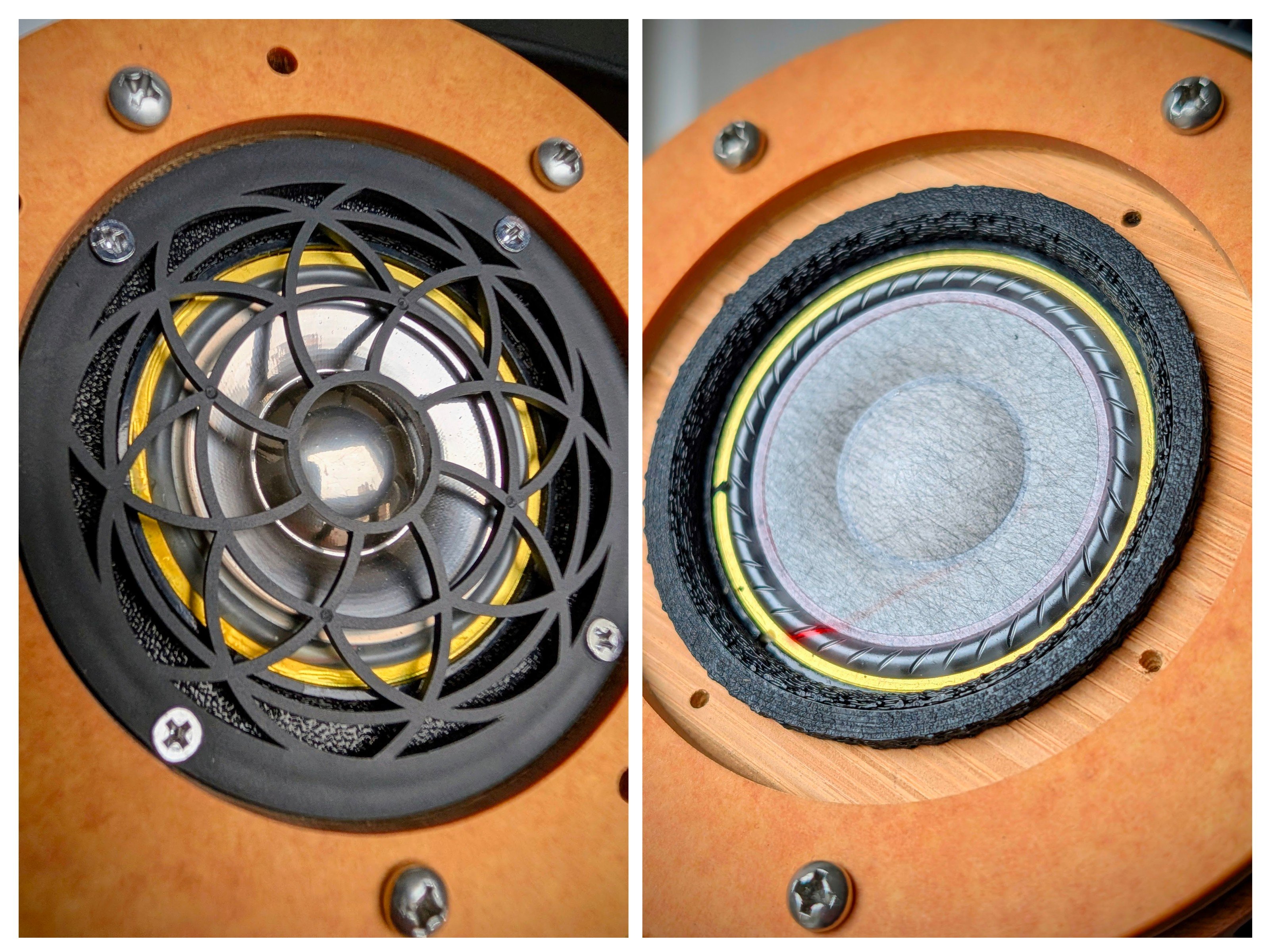
Beryllium coated Verité diaphragm on the left and the biocellulose driver of the Atrium on the right.
After the release of the Atrium Open in Spring 2022, the Verité’s four-year reign as the sole ZMF flagship came to an end. Only a few months later, at the end of 2022, ZMF’s high-end line-up expanded even further when Zach and his team announced their first proprietary planar headphone: the Caldera Open. The dynamic driver flagships start at $2,499, but with the Caldera we see both a jump in price and in technical performance. The Caldera Open starts at $3,499 and features unique planar transducers with patented magnet technology (CAMS). Its impedance is only 60Ω, but the sensitivity is 95 dB/mW. While none of these three headphones are extremely difficult to drive, they all clearly benefit from proper desktop amplification.
With the Atrium, the also patented Atrium Damping System (ADS) came to existence. Verité didn’t have this yet, but since then it became an integral part of new ZMF releases like the Caldera, Bokeh or Ori 3.0. ADS is basically an airflow guiding system at the back of the earcups which helps to avoid unwanted reflections and results in a more natural, more open soundstage.
ZMF sound in general, approach to this review
ZMF sound is relatively well-known by now, but let me give a brief description. In fact, let’s start with Zach’s own words: “A lot of the ZMF sound has to do with the transient impulse, dynamic nature and the timbral characteristics. Not to say it doesn’t include FR stuff, like a slightly relaxed 3/6k area, but overall, the decay character and transient excitement with the relaxed upper mids make our headphones sound the way they do.”
In practice, this means some deviation from the Harman curve (Harman curse?), which results in a rich sound with excellent timbre, texture, lifelike, weighty notes and a lively character. ZMF sound is unlike anything else on the market. Some call it a ‘pleasant filter’ which the music is presented through. If you are after more neutrality and accuracy, you are better off with something like the Susvara or Susvara Unveiled. If you like to get lost in sweet tones and enveloping bass notes, ZMF could be your ticket. Of course, the ever-growing headphone palette of ZMF caters for a wider and wider audience; the company’s most neutral take is probably the Auteur Classic.

All of these headphones share the core ZMF characteristics: a natural, engaging and slightly warmer tonality with excellent texture and timbre. The Caldera (and the Ori 3.0) are the most organic sounding planar headphones I have heard to date, offering a thicker and more natural than usual, yet technical planar sound. Dynamic driver ZMF headphones sound fuller and lusher than any planar, but lack the technical abilities of the Caldera. I will attempt to highlight all the pros and cons when it comes to these choices. I love all these three headphones, so when I mention weaknesses, please keep in mind that it is only true in direct comparison between them and not in general. For example the Atrium is detailed enough for the price, just not the most detailed in its price range. At the same time, Atrium has exceptionally unique strengths that simply no other headphones possess.
Gear used
My main gear chain is Eversolo A6 streamer with LPS upgrade upsampling to 192 kHz, Cyan 2 DAC, ZMF Aegis amplifier with special NOS tubes: Mullard 5U4G (thin base, black welded plates, pan getter), Mullard ECC35 (slim base, 1952) and different power tubes: Philips 4689, 4699, Philips EL51 (black base), Philips EL50 (metal base) and Mullard EL50 (mesh plate, RAF certified).

I find the Aegis to be a fantastic match with all ZMF headphones from the Bokeh open to the Caldera. Low impedance planars or high impedance dynamics all play very well on this amplifier. I also spent a few hours with the ZMF OTL amplifier, where the Verité particularly shined!
ZMF Atrium open
Sound
If I had to describe the Atrium in a few words, I would say it is rich, lush, dense, organic, analogue, natural, full, warm. I can completely understand the Atrium fans, as this sound is unique and ever so satisfying. When ZMF comes up in a conversation, many people instantly think of the Atrium’s organic richness. Mids and particularly vocals have outstanding tone and timbre. Vocals run like liquid honey: they are sweet, euphonic and tonally as lifelike as it gets. In my opinion, this is the very strength of the Atrium; serving mids like no other headphones can. For this alone it is worth purchasing them.
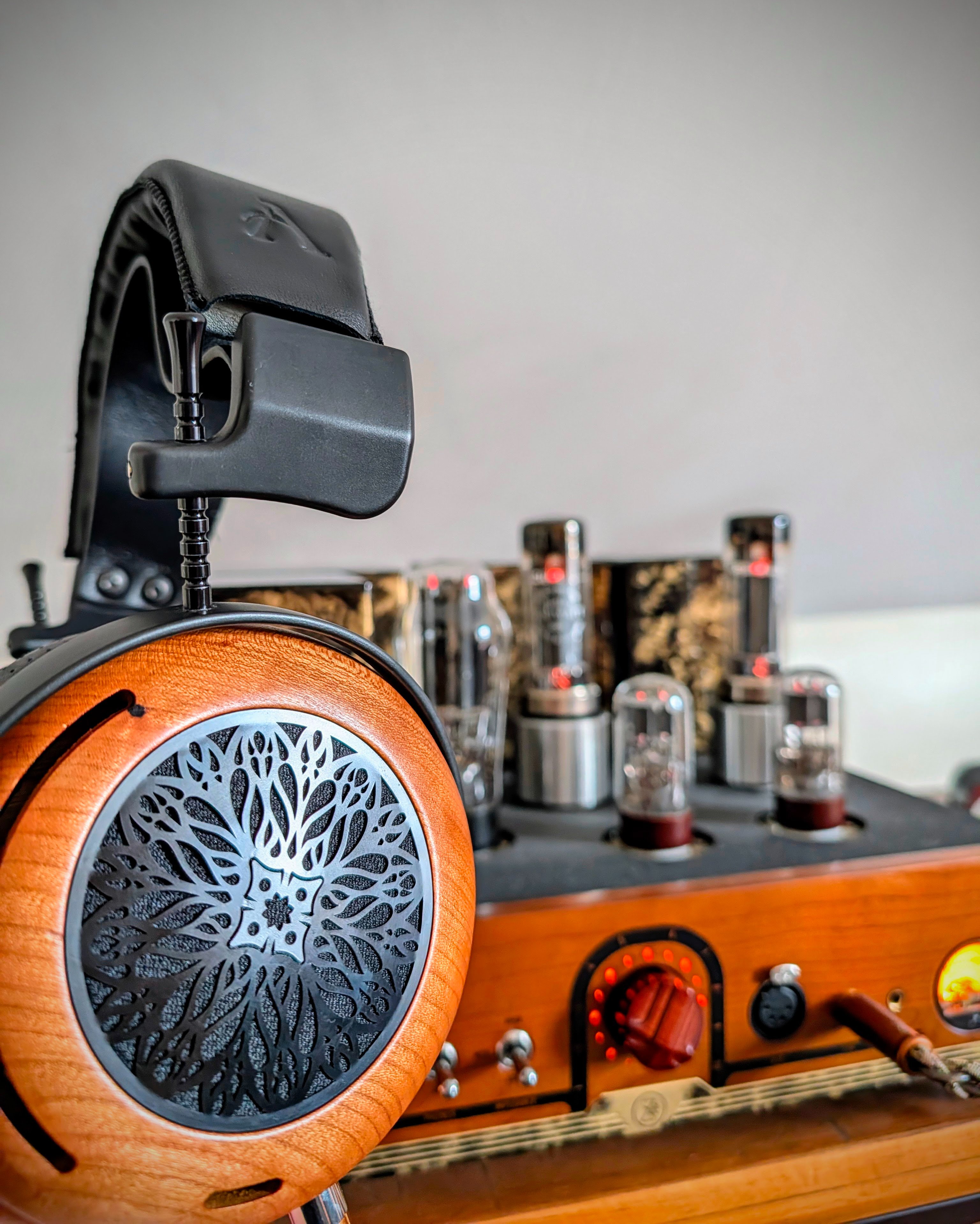
Stock, cherry Atrium.
There is bountiful mid-bass, which enhances the feel of warmth, and slams with great energy. That said, it is not the most technical bass around this price range. Clarity, separation and detail lack a bit even versus the Verité. This bass is not for those who like to analyse and separate clean bass lines, but for those who enjoy a solid and generous foundation to those sumptuous mids.
Upper mids sound clean and clear, nicely compensating for the muscular mid-bass area. As we go higher up on the frequency range and reach treble, this clarity slightly fades away. Similar to the lower bass regions, extension, clarity and separation becomes a little bit foggier versus the other two headphones under scrutiny. Do not get me wrong, treble is there, it is just extremely inoffensive with softer, more analogue snares and percussion hits. There is a lack of zing, spiciness or sense of snappiness in the treble. Some will prefer this super-ear-friendly presentation, while others will miss a bit more detail, crispness and bite.
To me the slightly less defined bass and treble presentation only drives my attention even more to the supremely gorgeous, honey flavoured mids.
Attack is energetic on the Atrium, but it is not sharp at all. It feels like a sledgehammer but under a comfortable blanket, if I am allowed to use such confusing metaphors. Decay is longer, which contributes vastly to the Atrium’s lushness. These headphones also have excellent 3D imaging and soundstage depth thanks to the patented ADS system.
Another strength of the Atrium that I would like to highlight is the complete absence of listening fatigue, despite the energetic sound profile. Perhaps treble is not as incisive as it is on the Caldera or on the Verité, but in exchange, this sound will never, ever become too much for the ears.
Tuning
As I am sure most readers are aware, ZMF headphones are highly user-tuneable with meshes and earpads. @heliosphann wrote a very comprehensive comparison of all Atrium earpads, which I can mostly agree with. Let me still go through some of the pads, which I selected based on a popularity vote that I created in the Atrium thread a while ago, in preparation for this write-up.

Universe pads
Without a question, to me the best tuning of the Atrium is the stock configuration: leather Universe pads with stock mesh. This is the most pleasing, most balanced sound with the best staging and dynamics. Of course, the generous mid-bass quantity is present, but staging depth and imaging accuracy is the best with these pads.
One thing that is worth noting is that the Universe pads have evolved throughout the years. I had two older versions as well as a brand-new pair and the newest pads to me felt firmer and sounded the cleanest and most dynamic. The softer, older pads with different perforation sounded a bit flat and hazy to my ears.
The new Universe leather pads are easily my number one pads on the Atrium.
(Zach told me that the earpads have the same foam and they measure identically, so the two older demo pads were just probably a bit worn. I recommend buying new pads if you feel they become too squishy.)
Ultra-Perforated Caldera leather pads
These would be my choice number two. These pads sound a little more dynamic, they somewhat pull back mid-bass and place vocals a little further away. The slightly more recessed mids won’t be to everyone’s liking and somehow staging is also not quite as accurate as on the (newest) Universe pads.
Suede pads in general
I usually dislike suede pads on all ZMF headphones and this experiment hasn’t changed my views. Suede pads display the main characteristics of their leather counterparts but soften transient response in general and slightly decrease the sense of detail retrieval. If someone prefers a smoother and softer sound, suede pads can work, as they are tonally pleasing. However, to me they take away too much of the original, lively ZMF character and dynamics.
BE2 pads
While I quite like the BE2 pads on the Verité, on the Atrium they are definitely a no go. The sound becomes way too forward to my liking. These pads highlight mids with good dynamics but somewhat suppress bass and treble, enhancing the sensation of roll off in both directions.
Auteur pads
These could be my number three pads, as they are not offensive in any way. Staging is pretty good on the Auteur pads with increased depth and height but decreased width. An interesting alternative, but not as good and balanced as the stock Universe pads.
Mesh
I find the stock mesh perfect. Solid mesh adds extra damping to high frequencies which can be good for super-treble-sensitive listeners but to me it just dulls the sound. Not having any mesh leads to imbalanced treble presentation to my ears.
ZMF Verité open
I feel that the older Verité has become a bit forgotten in the shadow of its newer siblings. It is a shame, as I think the Verité deserves to be right up there with the Atrium and Caldera. Perhaps the older dynamic ZMF model is a little more challenging to fully understand, as I think it requires more careful amplifier pairing.
If I had to briefly describe the Verité, I would say it is organic, balanced, crisp and clean with a great natural tone and sparky treble.
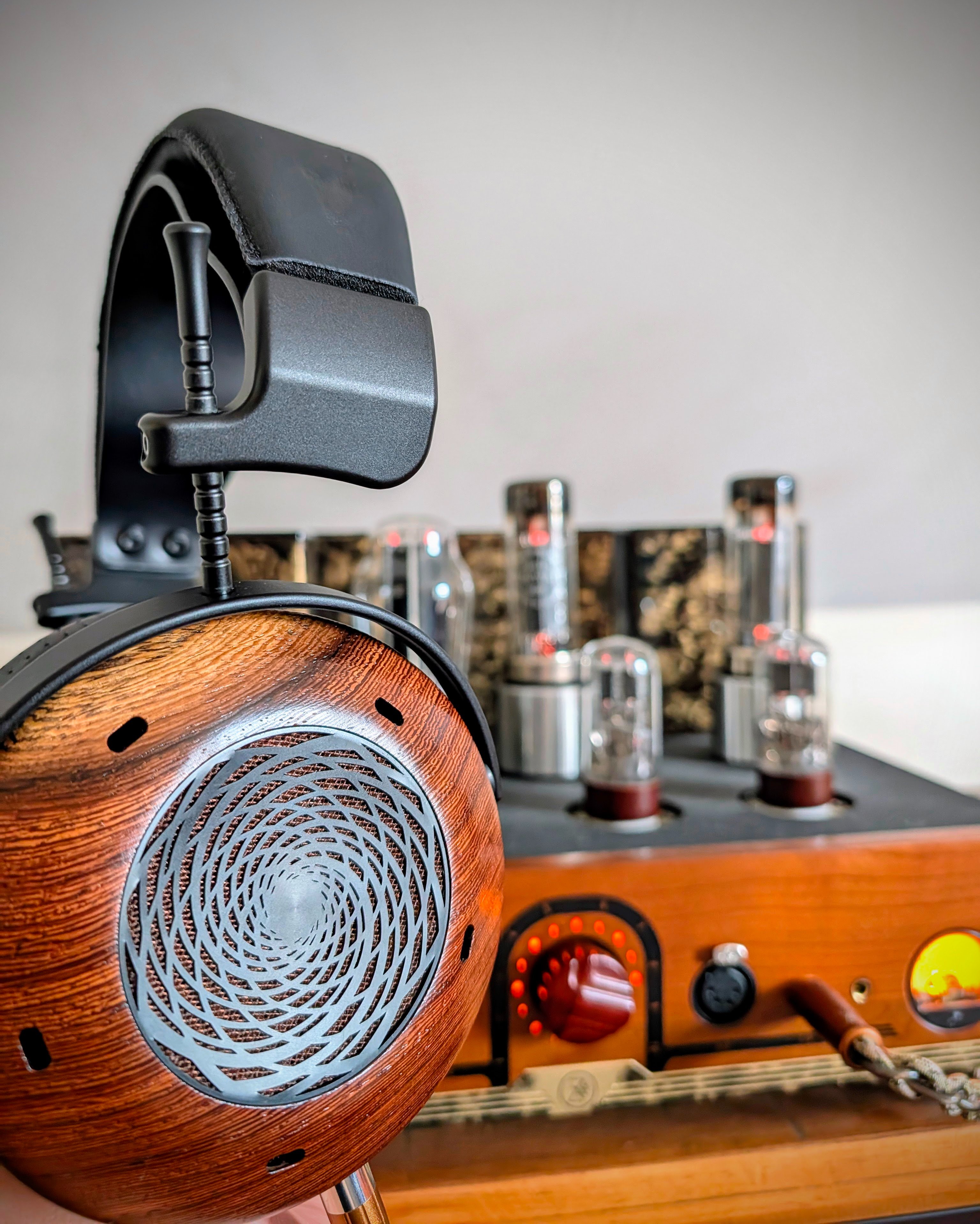
Beautiful Wenge wood.
Coming from the Atrium, I notice a few major differences that immediately pop out. First of all, the sound is much more linear and balanced. There is no big mid-bass emphasis and extension to sub-bass is a little better. Mids are still organic and signature ZMF mids, but versus the warm lushness of the Atrium they sound a little cooler, a little drier, although definitely not dry in the traditional sense. Treble extension is also better, there is a lot more sparkle, clarity and air in the upper frequencies. This clearer and brighter treble gives the impression of a more detailed sound versus the Atrium.
Verité versus the Atrium sounds more immediate, more forward and displays exceptional control for dynamic driver headphones. Another major difference after the linearity and treble clarity is in staging and imaging. Both of these qualities are still very good on the Verité, but not quite as accurate and spacious as on the Atrium (or Caldera). Verité portrays a significantly shallower stage, but left to right imaging is actually wider with better separation than on the Atrium. Thanks to the ADS system, imaging on the Atrium feels more 3D (deeper). Verité also sounds more neutral than the warm Atrium.
Overall, the Verité is tonally more balanced, still with adequate bass for most music genres. This bass however is not quite as muscular as on the other two headphones. For modern music I would go with the other two, although Verité bass on the right amplifier is no slouch either. In my opinion, when it comes to amplifiers, out of the three headphones the Verité desires tubes the most. The sparklier treble from the beryllium drivers can have a slight mechanical shimmer on certain solid state amplifiers, but can be a truly perfect marriage with warm and liquid sounding tube amps. As all ZMF headphones, the Verité also sounds fabulous on the Aegis, but I was really struck when I spent a few hours with them on the ZMF OTL amplifier.

Magical OTL amplifier.
The lush, liquid warmth of the OTL amp compensated for the sparky and ever so slightly drier nature of the Verité extremely well, leading to a truly magical experience. There was clarity coming from the beryllium drivers that we do not often hear on OTL amplifiers and the output transformerless circuit lent Atrium-like tone and timbre to the Verité. The shallower stage of the Verité is also very well-compensated on good tube amps, especially on OTLs. In my opinion the Verité was certainly made for tubes! Astonishing pairing! At the same time, Atrium’s bassy nature became slightly over the top for my preference on this OTL amp and preferred them on the Aegis.
Tuning
Universe leather pads
Similarly to the Atrium, my preferred configuration is the stock Universe pads on the Verité, which comes without any meshes by default. Stock pads once again have the best balance, great dynamics and best staging accuracy.

Suede pads
I have the same opinion on all suede pad varieties that I described at the Atrium.
Caldera Ultra Perforated leather pads
These sound a little more forward and more dynamic, slightly more aggressive. I didn’t find these as pleasant, as balanced and as refined as the stock Universe pads.
BE2 pads
While I really disliked these on the Atrium, I find them to be a viable secondary option on the Verité. These pads increase stage depth, and also place vocals a little further back. They sound slightly less dynamic, but overall quite nice, smooth and engaging. These are a little warmer and softer than the Universe or Caldera Ultra Perforated pads, but not overly so. Despite the better depth, the soundstage as a whole feels smaller. Upper mid/treble area is slightly less clear and less expansive.
Mesh
The Verité in stock form does not come with a front mesh. (Early units had a mesh with a swirl pattern, but this was discontinued.) While the effect of the perforated mesh is not as dramatic as it is on other headphones, I feel it is unnecessary. Still, if someone finds the treble notes too forward, this is a polite way of taming them. Solid mesh once again applies too much front damping for my taste.

Alternative perforated mesh on the left, discontinued original mesh on the right. (This photo is from a Google search page.)
ZMF Caldera open
As I have reviewed both the Caldera open and Caldera closed, I will be brief here. ZMF’s first planar is a clear and obvious step up in technicalities versus the older dynamic driver siblings. If I had to describe the Caldera in a few words, I would say it is organic, punchy but smooth, refined, accurate, detailed, balanced, mature. The Caldera is the most neutral out of these three headphones, but not as neutral as the Susvara or Susvara Unveiled for instance.
Versus other planar headphones on the market the Caldera sounds thick, weighty, organic, rich and natural. In three letters, it sounds like ZMF. On the other hand, when we compare the planar flagship to its dynamic predecessors, it cannot quite reach the lush and thick mids of the Atrium or even the Verité, due to the laws of physics. Those dynamic drivers, especially the biocellulose Atrium, will offer richer, more physical, almost tangible mids and vocals with better body.
Caldera at the same time is simply a class above them when it comes to technicalities: bass extension, authority, control, detail, instrument separation, imaging, resolution, clarity are all next level on the planar flagship.
My first higher-end headphones were Audezes, starting with the LCD2. Then I moved on to the first Empyrean in 2018, Final D8000s, Meze Elite and so on. My background is in planars, therefore I really appreciate the extra body and organic timbre the Caldera brings to this technology. I am used to planar technicalities, bass quality and resolution. With perhaps the exception of the Utopia, dynamic driver headphones simply cannot keep up with planars.
Other headphone enthusiasts are all about those lush and natural mids with a big mid-bass slam that dynamic drivers can bring to the table and they dislike the leaner planar timbre. This is personal preference and the choice will depend on favoured music genres, amplification and sonic priorities. While the Caldera (and Ori 3.0) came really close, we still cannot quite have Atrium mids and Caldera technicalities in one chassis. All of these headphones are fantastic, but when it comes to sonic priorities, they simply tick the boxes in a different order.

As far as my personal preference goes, I simply cannot live without the technical level of TOTL planars and so far, the Caldera offers the best timbre and tone out of them. I love the lush mids of the Atrium and the clean, dynamic presentation of the Verité, but to me they would be flavour headphones in my collection focused on vocal centric/acoustic music and not all-rounders like the Caldera.
Tuning
In my Caldera review you can read my detailed earpad impressions. I prefer the thick leather pads on my Caldera open. While the stock pads are more balanced and certainly more neutral, I enjoy the slight bass emphasis, enhanced soundstage depth and smoother upper-mid-treble response of the thick leather pads.
The mantle mesh once again brings too much front damping for my taste, dulling higher frequencies.

Summing up the comparisons and mentioning other brands
I can utterly enjoy all three of these headphones. The winner for my taste and usage scenario is still the Caldera open, but second place is equally shared by the Atrium and Verité. The top dynamic ZMF headphones have different strengths and weaknesses, but both are equally awesome once understood and properly paired within a system. The Caldera is on a different technical level with higher resolution, which I simply cannot live without anymore — even if planar mids will probably never sound like good dynamic drivers. With my music and taste, I value the superior linearity of planar bass, treble clarity, openness, and refined nuances more than midrange timbre and body alone. The Caldera still offers just enough signature, organic ZMF tone/timbre to satisfy my needs for vocals and acoustic instruments.
In direct comparison, of course the rich and lush ‘honey’ mids of the Atrium are addictive. Atrium’s vocal presentation is liquid gold and the analogue sound of the headphones with wood reverbs create a truly unique experience. Perhaps it is not the cleanest, clearest and most detailed presentation ever, but catapults you to a very comfy and magical place where listening is pure joy.
Verité deserves a push, as they are nothing less than exceptional on tube amplifiers, especially on OTLs. This older model sounds more linear, better balanced than the Atrium, with more treble sparkle and detail. I would say, the Verité on tube amps could be a straight upgrade to HD600 fans. (And perhaps the Atrium to HD650 fans.)

These numbers are to indicate the differences as I perceived them. This is only to give a rough idea and not exact science.
I covered many comparisons to other brands in the various separate reviews that I linked into this write-up. Let me just say that there is nothing like ZMF out there. Something like the HiFiMan HE1000SE or Unveiled will offer more details and higher resolution than the Atrium/Verité at a similar price point, but won’t have the utterly unique selling points of ZMF: a coherent, organic, rich tone with lifelike timbre. I like the Final D8000 series, especially the new D8000 DC. Wonderful headphones, but Caldera sounds more organic. I also love the Meze Elite, which is softer, more laid back and more spacious than the Caldera. These days I simply enjoy the more organic and weightier sound of the Caldera. Susvara Unveiled is a step above the Caldera in resolution, detail retrieval, balance and neutrality, but doesn’t have the note weight and organic nature of the ZMF flagship. Caldera versus the Susvara Unveiled pretty much sounds like the Atrium versus the Caldera: less technical but thicker, richer and more organic.
The DX6000 is a really nice new dynamic headphone from Final, but again, it doesn’t have the lush naturalness of ZMF. I could carry on, but you catch my drift.
A few example tracks
 DJ Shadow – Three Ralphs: Sub-bass extension and presence on the Caldera is simply superior. Verité does a little better than Atrium, Atrium rolls off sooner.Vibrasphere – Northern Sunset: Percussion is a little sharper on Verité, with a more metallic zing in a good sense. Atrium feels warmer and more rounded. Caldera the most neutral, most incisive.Lamb – We Fall in Love: Background percussion on the Verité feels more like when the wooden drumsticks and metal plates meet in real life. The same notes feel a little over-damped on the Atrium.Sync24 – Inadvertent: Atrium gets a little boomy with that generous mid bass. I don’t hear the usual bassline and treble clarity this track clearly offers on the Caldera.The HU – Wolf Totem: Fantastic track on the Atrium. There is no harshness at all, yet all the energy is conveyed perfectly.Corvus Corax – Skal: This track can be quite harsh on certain headphones, but there is absolutely zero fatigue on the Atrium. Once again all the raw energy from the track comes through. Treble and bass at the same time are not quite as detailed as on the Verité or Caldera.Heilung – Anoana: Female vocals are forward and pronounced on the Verité. Both Atrium and Caldera place vocals a little further away. Atrium’s warmth hides a bit of bass clarity. Caldera is the cleanest and clearest with the best separation and detail retrieval.Garmarna – Ramunder: This treble intensive track sounds the most pleasant on the Atrium, but it is a little bit of a ‘nice lie’. Verité’s tonality feels more accurate and Caldera presents the track in a higher resolution than both dynamic drivers.Yello – Kiss in Blue: Verité’s more open upper mids really help female vocals, but slightly thin out male vocals versus the Atrium’s bigger upper bass/lower mid body. Caldera is not as lush, but much more accurate.Vivaldi – Spring Allegro (London Mozart Players): Excellent on all three headphones, but Atrium clearly wins on instrument timbre. Verité has great left and right separation (better than Atrium), but there is less stage depth. Atrium feels narrower but deeper than Verité. Violin timbre is to die for on the Atrium, but beyond the centre image we lose a bit of clarity. Caldera offers the cleanest and most resolving picture; a noticeable step up. This planar body and timbre, while still exceptional, is not quite on the level of Verité/Atrium due to the physical nature of the different driver technologies.
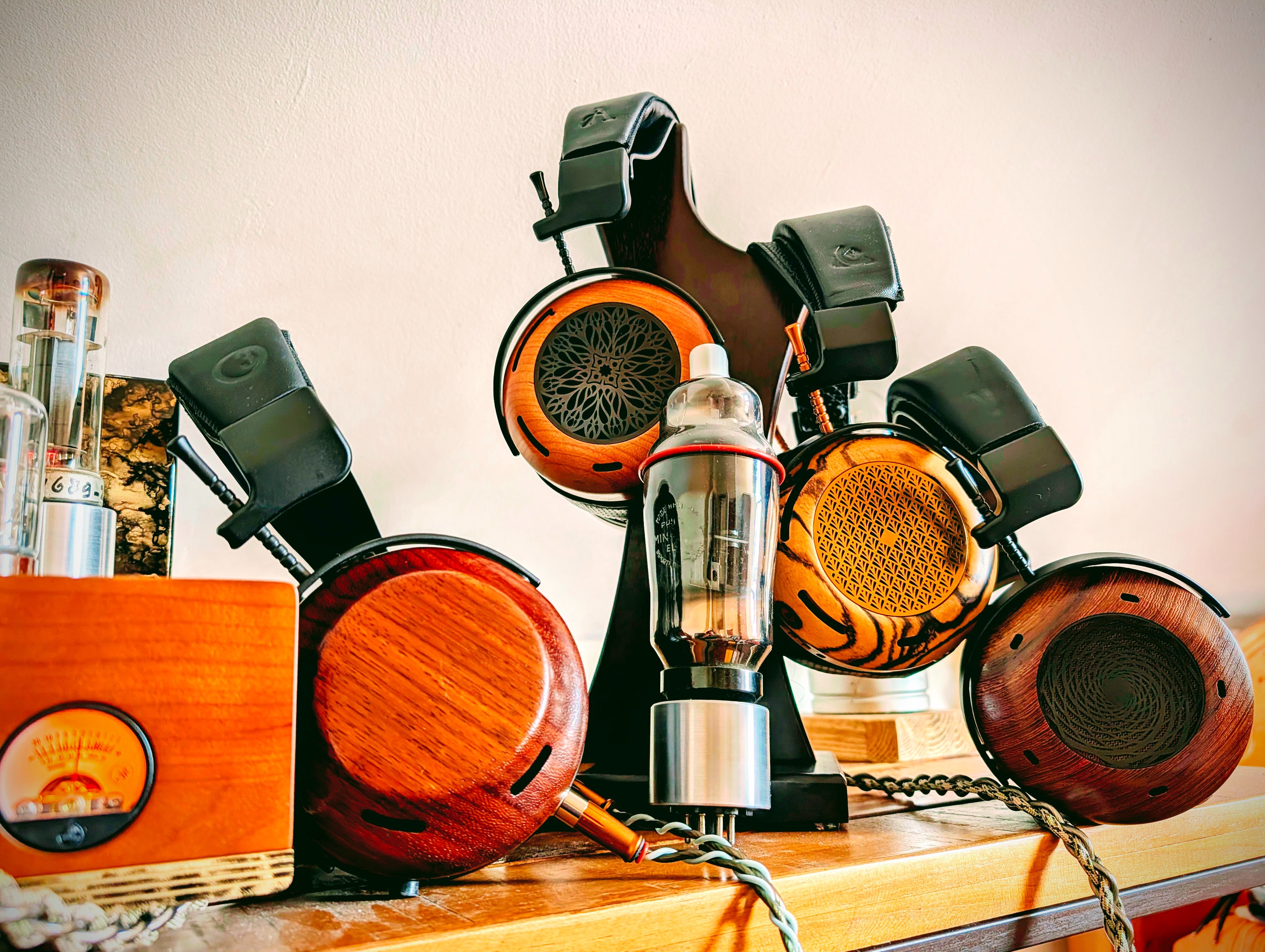
Conclusion
I hope I managed to paint a helpful picture of how these three headphones relate to each other. There is no ultimate winner, but everyone can have their personal winners depending on taste, sonic priorities, favoured music genres and chosen gear/amplifiers. Those fortunate few can own them all and rotate them upon mood. At the end of the day I could be happy with any of these wooden masterpieces. Since I already own the Caldera, the question is which dynamic pair would I choose as a complement to my flagship ZMF planar. Prior to this review I thought it would be the Atrium, but I am not sure anymore. I absolutely love the biocellulose ‘analogousness’ and timbre of the Atrium, but the balance and accuracy of the Verité on tube amps is also incredibly captivating and sits closer to my tonal preference. I honestly couldn’t choose. One day I might just have to become like some folks here and own every single ZMF model.