Pros: build quality
– generous amount of accessories
– free iPurifier3 with the first 1000 units
– quality and functional carrying case
– clean, dynamic and punchy sound
– better detail retrieval than most similar products
– enough power to drive literally any headphones
– it can drive speakers via fixed balanced output
– red colour
Cons: despite the amount of accessories still a bit pricey
– free iPurifier3 is limited to the first batch
– after a few hours of listening you might want a smoother sound
– not as natural sounding as similarly priced desktop amps
– low volume channel imbalance
– less than brilliant volume control
– unnecessary amount of power for most headphones
Intro:
iFi has kindly lent me the Diablo in exchange for my honest opinion. I reviewed and owned several iFi products during the years, so hopefully this write up will give you a good picture where the Diablo stands in iFi’s product line and what sort of sound and user experience you can expect from it.

What is the Diablo and what it is not?
The iDSD Diablo is iFi’s best and most expensive (trans)portable DAC/amp to date, with a retail price of £899. It is not another iteration of the Micro iDSD Black Label, not an improved iDSD Signature edition. The Diablo was designed from the ground up, and unlike other portable iFi DACs with S-Balanced technology, this new DAC/amp offers a completely separate and fully balanced circuitry. At the front we find a 6.35mm(1/4 inch) and a 4.4mm balanced headphone output, at the back of the unit there is a 4.4mm fixed balanced output for speakers, along with a shared spdif/optical input.
iFi’s flagship portable DAC/amp is a real beast when it comes to maximum power output. With its five watts into 32ohms it even surpasses the already powerful four watts of the Micro BL and Signature models. At 600ohm the Diablo still outputs 611mW which is more than respectable. This is more power than the majority of desktop headphone amps. (Its single ended output does 2.5 watts and 153 mW respectively.)

How I did the testing?
I spent my first two weeks with the Diablo only using the single ended output. Then my 4.4mm balanced headphone cable arrived, so I was able to test iFi’s newest release to its full potential for another couple of weeks. I keep my portable gear pretty basic these days, so my best reference when it comes to describing what I heard is my trustworthy RME ADI-2 (£850) which is a desktop DAC/amp, but it is very popular and priced around the same. In the Diablo thread I saw quite a few requests to compare the sound of these two devices.

What is in the box? + First impressions
iFi has been known for its Swiss army knife audio products with the Micro iDSD and Pro series. These all have a generous amount of switches, filters, selectors. Many reviewers back then said: what if iFi would ditch all the bells and whistles and would come up with a product that focuses purely on sound quality without any additional extras. iFi has listened and released the Neo and now the Diablo.
It is funny to read some of the first impressions about these products saying: ‘if we only had those switches and selectors from previous iFi products’. I guess the audiophile crowd is pretty hard to please.
While I personally did miss the bass switch from the Neo (not the 3D switch), in my opinion the Diablo does not need them at all. This time iFi has nailed the sound tuning without them. (I know, the Neo iDSD was meant to be a more neutral tuning, but its single ended output simply sounded thin and rolled off to me.)

Unlike the Neo, the Diablo comes with an extremely generous amount of accessories: several cables, even a 4.4mm to double balanced XLR cable for connecting speakers, a carrying case and an iFi iPurifier 3.
Carrying case

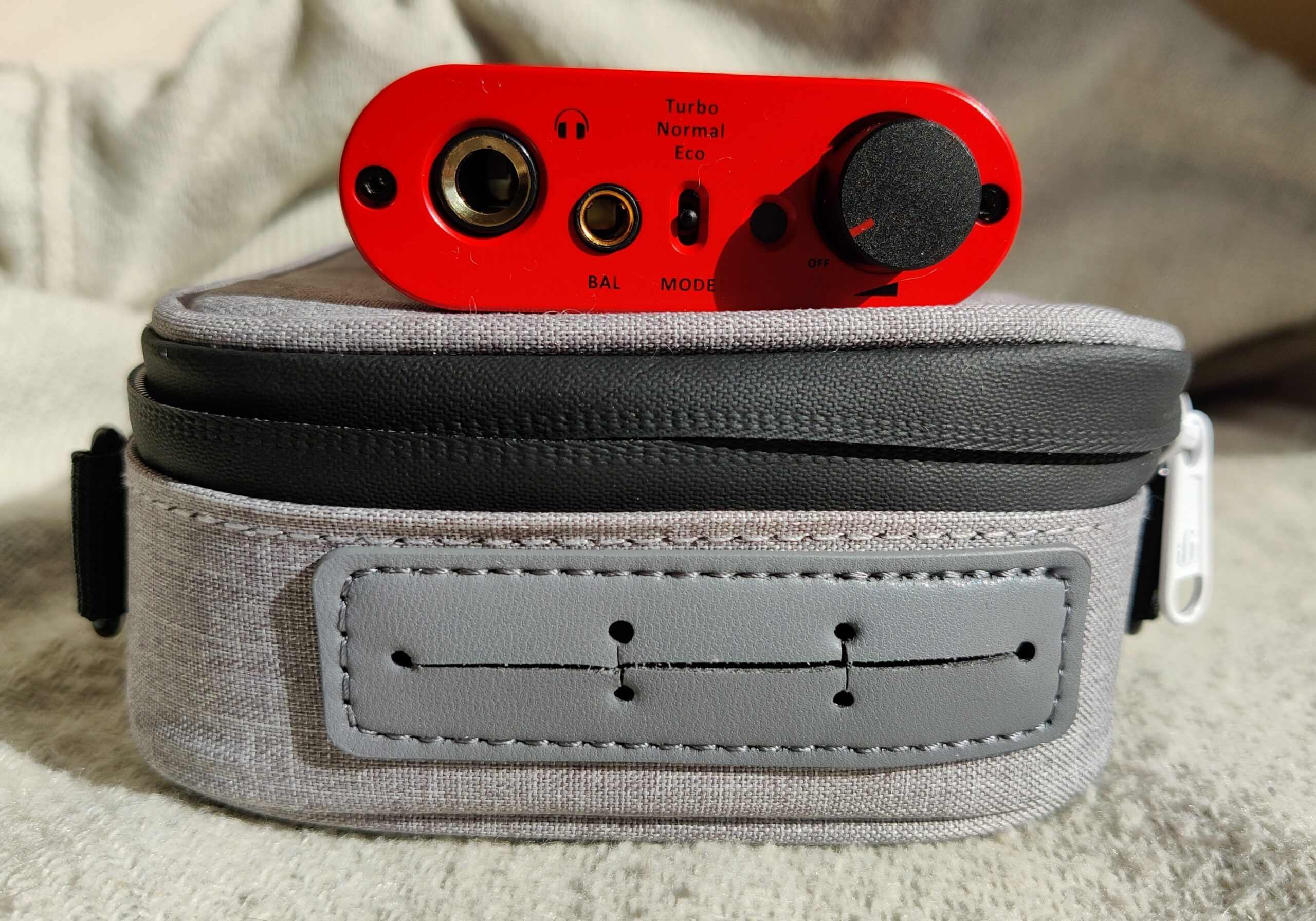
The carrying case is good quality and its functionality is very well thought through. It is not too large, but there is plenty of room in it for everything including your mobile phone or choice of audio source. There are smart solutions to drive through your cables in a comfortable and non-disturbing manner.
iPurifier 3
The first 1000 Diablo also comes with an iPurifier 3, which normally retails for £129. This definitely increases the value and makes the Diablo a better buy. It is not quite possible to use the iPurifier while the Diablo is in the carrying case, as it sticks out in a slightly awkward way. For home use on the other hand, this little signal purifier is indeed a useful addition.

In my experience the iPurifier 3 definitely improves sound clarity with the Diablo and some other DAC/amps, while for example with my Chord Qutest which has galvanic USB isolation it made no difference.
I definitely recommend getting one of the first 1000 units, but I would think twice whether the improvements are really worth another £129 on the top of the £899 asking price once the first batch is sold out. For some customers it is going to worth the extra money, for others it won’t.

Build quality
I love when a company dares to do something different and has the courage to take some risks not pleasing everyone with a unique design choice. While they might lose few fussy customers, the marketing value of being different will definitely make up for it.
In my opinion the distinctive red colour of the Diablo was a good choice; I find it great not having to look at another boring black or grey brick.
iFi has definitely demonstrated this kind of boldness before; for example coming up with some unorthodox external design on the Zen series which I also like. The Diablo is a big red splash in the boring looking water of portable devices: I find it refreshing.
Build quality is excellent as always from iFi, and the paint finish does seem strong enough to take some beating.
Eco, Normal, Turbo modes

Most of the switches from the Micro BL and Signature are missing from the Diablo, all you get is a tiny selection knob between Eco, Normal and Turbo mode. Even Normal mode will be more than enough do drive 90% of the headphones. I have not had the chance to try IEMs, but some users in the Diablo thread reported, that the iDSD Signature might be a better choice for IEMs due to an even lower noise floor in Eco mode.
What I can say is that the Diablo already has plenty of power in Normal mode to drive some big planar headphones. To be honest I feel in most cases this is almost an unnecessary amount of power in a portable unit.
The volume control
I have one major (and basically the only real) gripe with the Diablo, and that is the volume knob. It is analogue which is great, but due to the extreme power there is hardly any room for volume adjustments. With my Audeze LCD-X in Normal mode I was only able to use it between 10 and 12 o’clock. Below 10 o’clock there is a slight channel imbalance like on the Micro BL, and above 12 o’clock it is already painfully loud. This combined with the fact that the volume knob turns extremely easily, can often lead to accidental volume adjustments which even has the potential to blow your headphone drivers or eardrums if you are not careful.

I am also not a big fan of the tactile feedback and touch of the volume pot. A stiffer and wider aluminium pot with more resistance and better control would have been a much more practical and elegant solution.
Portable vs. desktop use
The Diablo is a portable DAC/amp and for that it sounds pretty phenomenal in both single ended and balanced mode. I was unimpressed by the Neo iDSD’s performance in single ended mode for the price (£699), but I am happy to report that this is not the case with the Diablo. The Diablo in single ended mode sounds energetic, punchy, dynamic and fun. It is indeed an improvement over the Micro BL: better clarity, detail and more energy.
In my opinion you would be hard-pressed to find a better sounding portable unit for the price. The story is slightly different when it comes to desktop alternatives for the same money, but even in that ballpark the Diablo has no reason to shy away.
That said, I do not think the Diablo is an ideal choice to replace desktop systems, let me elaborate.
First of all the Diablo is a battery powered device. It can become frustrating to lose power every 7-8 hours in the middle of a film/movie or your favourite album. It is also not ideal to keep the Diablo plugged in to the main power 24/7 as this DAC/amp can only be powered through the battery which will be in constant trickle charge mode. Even though there is a wall plug included in the box, the Diablo cannot bypass its battery. Occasionally it is fine to use the device like this for a couple of days, but I would definitely avoid doing so for months.
Another reason why in my opinion the Diablo is not the best choice to replace your desktop combo is the sound tuning. It is impressive and extremely dynamic which is ideal when you are out and about but after a few hours it can get too much when you are listening in a quiet room. While I find the sound fun and impressive, after 2-3 hours of listening I had to switch to something smoother and more relaxed like my RME ADI-2. I must add that my ears are probably more sensitive than the majority of Head-Fiers.

Sound
General impressions
In my opinion the sound was definitely tuned for portable use, meaning it is a bit more coloured and more exciting than most desktop gears these days. It is a punchy sound with slightly elevated bass and increased dynamics to compensate for the potential background noise of a plane or train.
The bold, detailed and energetic sound of the Diablo will impress at first glance. Whether it is easy to live with it long term depends on usage scenario.
Technicalities
The Diablo’s sound is technically pretty impressive: wonderful dynamism with excellent extension. Detail retrieval is also superb, to my surprise it is pretty much on par with the RME ADI-2 when iFi’s newest creation is supported by the iPurifer3.
Instrument separation is great; clarity is excellent, even if we compare it to similarly priced desktop gears. In portable category I have not heard better and more convincing performance for the price yet.
Soundstage is a mixed bag. There is definitely a good 3D feel to it, but it is not very spacious. Even my RME ADI-2 has a bigger space with more room to breathe in the higher frequencies.
In comparison the Diablo has slightly better soundstage depth, but the stage is definitely narrower. In this relatively smaller space everything is very well placed and clear with excellent separation.
The Diablo uses two Burr-Brown chipsets and it is an excellent example of the fact that implementation matters as much if not more than the chipset itself when it comes to sound characteristics. I have never heard a Burr-Brown device this clear, detailed and punchy before (except iFi’s Pro series). Other Burr-Brown DACs often lack clarity and sound very smooth and warm, but not the Diablo. The sound is still a bit on the warm side (less so in balanced mode), but there is not a hint of detail loss in the treble or unrefined bass.

Bass
To me this is the most impressive part of the Diablo. Its bass performance is pretty phenomenal; the deepest notes are easily audible with excellent separation and clarity. The bass energy and thump is very pleasing and something I really appreciate. There is a few dB elevation from neutral, but I think iFi managed to hit the sweet spot here without implementing their usual bass enhancement options. It is a tastefully emphasised, clean and energetic bass I really enjoy. This bass energy is missing from the RME ADI-2. While the RME’s bass is also clean and satisfying, it is nowhere near as punchy and dynamic as the Diablo’s regardless what bass enhancement option you try on the German king of sound tuning options.
Mids
Luckily despite the energy the bass stays where it is meant to stay and gives space to the mids as we climb higher on the frequency ladder. The mids on the Diablo are slightly forward and clean. The singers are well-separated without being overshadowed by any instrument. It is a relatively intimate stage but all instruments are equally visible; I mean clearly audible.
Treble
The high frequencies are nice and clean, just as dynamic as the rest of the sound. They never come across as harsh, but I also would not call them relaxed. It is an energetic treble performance with all its pros and cons.
What I started to feel in the mids, intensifies in the treble: we are running out of air and spaciousness in comparison to full size desktop amps or even compared to the RME ADI-2.
I start to feel not just a narrower soundstage but less space to breathe on the top: almost like hitting the ceiling of a studio versus the open space of a concert hall.
It is still nice and enjoyable, but a relatively average desktop amp or the ADI-2 represents the space of the recording in a more natural way.

More on the Diablo vs. RME ADI-2 and other DACs
Since the two devices cost about the same, in a way it makes sense to compare them, but we must keep in mind these products were designed with a different purpose in mind. The Diablo is a masterfully coloured and intense sounding portable unit while the ADI-2 is a desktop DAC/amp from a company whose focus is usually on clean and neutral sounding studio gear.
The RME without enabling any kind of EQ or DSP sounds dead neutral and kind of boring in A/B comparison. This can be good or bad, depending on what someone is looking for. Luckily the ADI-2 has endless possibilities to tune and change the sound, so it can be brought quite close to the Diablo’s level of colouration. The loudness function elevates bass and treble (this function has to be set carefully to avoid overdoing the effect), soundstage width can easily be increased, and then there is crossfeed, bass/treble knobs plus parametric EQ, filters and so on. I did and do use some of these DSPs on my ADI-2.

When I compare the Diablo with iPurifier 3 to my RME with some of my settings, there are some surprising similarities and surprising differences at the same time. The level of detail retrieval is about the same. Instrument separation is equally good, but even with the enhanced settings on the RME the Diablo simply sounds more exciting, more dynamic and punchy. I prefer the bass on the Diablo as it hits harder. The RME in comparison is smoother and more relaxing while it is equally clean and detailed. After two hours on the Diablo, going back to the RME was a relief to my relatively sensitive ears. Beside vocals and acoustic instruments; drums and percussion also have a more natural and more realistic tone and timbre on RME’s device.
The Diablo is more fun but the ADI-2 offers higher fidelity in the most traditional sense and creates a more realistic feel of the recording space.
To finish this comparison let me use a speaker analogy. Like most analogies this is also far from perfect, but might give you an idea. The RME sounds to me like smooth and relaxing large floor speakers in a lounge, while the Diablo sounds more like punchy bookshelf speakers. They both are really good in their own right but very different. (I never thought of my ADI-2 this way until A/B testing it with the Diablo.)
How about the Micro BL and Chord Hugo2?
The Diablo is a clear improvement over the Micro iDSD BL in pretty much everything. In fact, it clearly beats every other portable DAC/amps I have heard under £1000. In my opinion the Diablo is not on Chord Hugo 2 level of sound quality, which would be the next step up on this never-ending audio ladder. That said, I think the Diablo has every right to be crowned as the new king of sub £1000 portable DAC/amps or at least to hold the majority of championship belts in the category.

Thoughts on single ended vs. balanced output on the Diablo
Even though the Diablo was designed with a balanced circuitry in mind; the single ended output is no slouch either. It is nothing like the one on the Neo iDSD which I found a bit powerless and couldn’t recommend for £699. The Diablo’s single ended output has every right to exist and everything I said above is true for both outputs. In fact, the performance of these two outputs is closer than on many other SE/balanced amps.
What the balanced output adds to the picture (apart from twice as much power) is improved clarity, even more punchiness and dynamism. It is a bit like drawing a picture on a deflated balloon, and then inflating it: everything becomes tighter with enhanced clarity. When switching back from balanced to single ended, it suddenly feels warmer and sounds less intense. I think it is quite good to have these two options. The balanced output is slightly superior in a technical way, but the single ended output is almost as good and offers a nice, warmer tone vs. the brighter sound of the 4.4mm output. To me the choice merely depends on my mood.

Conclusion
If you like a punchy, detailed and entertaining sound and you need a portable device, the Diablo is pretty much your best bet under £1000. With the amount of accessories, especially with the iPurifier3, I feel the £899 asking price is justified on today’s crazy audio market. It does not replace a well-chosen and similarly priced desktop combo for home use, but can be an excellent companion for traveling. I can easily recommend taking it with you for holidays or enjoying the freedom of movement around the house or in your garden with headphones that are usually tied to your desktop system by nature.
This little diabolos* can drive the most demanding headphones from the biggest planars to 600ohm dynamics with ease.
It can be quite fun to chill out in your garden chair with an adequately driven LCD4, Susvara or HD800S. That said I find this unparalleled amount of power in a portable unit overkill for most headphones. You also have to touch the volume knob carefully, if you want to avoid any regrets.
If you know what you are buying, I am sure this little red devil can bring a lot of enjoyment to your life and many happy customers to iFi. This much power and this level of sound quality in such a small form is indeed a great achievement.
* Diabolos is the Greek word for “devil”. It has entered many languages to mean devil, such as Diabolus (Latin), Diavolo (Italian), Diablo (Spanish), Diable (French), and Diabo (Portuguese). Diabolos actually means “accuser” or “slanderer” and could also be connected to the Greek word diabolous, which means “divider”.