Pros: – 3 months warranty
– excellent, clear, dynamic, engaging sound
– good quality, reliability, consistency
Cons: – as of now only available in the USA and Canada

Disclaimer:
Apos Audio kindly sent me a pair of their brand-new Ray 12AU7 vacuum tubes in exchange for my honest opinion. Everything you read here reflects my own experience and thoughts, I am not affiliated in any way.
Apos Audio:
Apos Audio is a California based audio retailer, but they are not your average retailers. They are truly dedicated people, which also shows in creating their own products like the Apos Caspian headphones, audio cables and now tubes. (The Caspian is a $500 headphone based on Kennerton’s dynamic drivers.)
Apos Audio is committed to tune, design and produce quality new production vacuum tubes. This is a big deal and shortly I will explain why. The 12AU7 is their first attempt. On this link you can give them ideas what other tubes you would like them to make and what sound you are after. I always find it exciting, when audio enthusiasts want to develop a project with the enthusiast community, as the potential in such cases is enormous. I have a feeling, there are a lot of good things to come from this project!

Why is it a big deal?
If you have ever dipped your toes into the vacuum tube world, I am sure you almost immediately realised the issues with today’s vacuum tube market. Vacuum tubes were invented in 1904, mass production started in the 1910’s and 1920’s. They were used in all sorts of electrical equipment. In 1947 three gentlemen invented the transistor, which effectively replaced vacuum tubes in the 1950’s and 1960’s. For a period of time, they co-existed, but the cheap and efficient transistor simply killed vacuum tube production.

Gold pins
I could go into a lot more details, but as the end of the 20th century was slowly approaching, more and more audio enthusiasts started to realise that this old technology in many cases sounded better than any transistor-based system. In general, amplifiers with vacuum tubes sound more euphonic, often (but not always) warmer, more lifelike and more engaging. The perceived spaciousness is also often bigger with a more accurate 3D imaging versus the narrower and more 2D sounding solid state amplifiers. To cut a long story short, unused, old stock vacuum tubes became very much sought after items. This, as I am sure you know, led to some insane price increases on the NOS tube market since supply is heavily limited.
Vacuum tubes are not really mass produced anymore, there are only three factories that make tubes these days: in China, in Russia and in Slovakia. These new production tubes are mostly made for guitar amplifiers, but also used in many headphone and power tube amps as stock tubes. The criticism towards new production tubes is often that they do not sound as good, as lifelike, as engaging as NOS (new old stock) tubes. Based on my experience I can confirm this. It is not that new production tubes are poor, simply the old production little glass sculptures tend to sound better.

Another big problem on today’s tube market is reliability and fake products. As everywhere else in life, swindlers can be found amongst eBay and other tube sellers too. NOS tubes must be sourced from reliable tube sellers, otherwise you might not get what you pay for. Even if you get what you pay for, these old tubes can fail and even the most reputable sellers usually do not offer more than two weeks return/warranty on them. Buying NOS tubes unfortunately is not only expensive but also a bit of a gamble.
Based on all we have read so far; the question might arise: why cannot we produce new tubes that sound as good as the old ones? This is another complex topic, enough for an essay. The main point is, producing good tubes used to be quite a special craft. The best tube making masters were highly respected. With the spread of the transistors, this craft got slowly forgotten. Nobody wanted to learn the subtle art of producing quality tubes anymore. Most of this knowledge died with those masters, and the little paperwork and documents we had got burnt or lost in World War Two and other disasters.
By now you might see why it is a big deal that Apos Audio took on this mission of creating high quality new production vacuum tubes. Let’s see, how their first attempt looks and sounds like.
My tube background:
I have been in the hobby for 12+ years. For a long time, I kept delaying my involvement with tubes as I always thought it was a too finicky and too expensive circle of audio hell (heaven?). Then about a year ago I bought my first transformer coupled tube amplifier, the Cayin HA-3A. It did not take long to get into tube rolling, I tried a bunch of 6V6, 22DE4 and 12AU7 tubes.
There are far more experienced members here than me when it comes to tube rolling, but I managed to gain a good insight into what rolling NOS tubes mean. I bought noisy, unmatched or simply unimpressive NOS tubes and also bought some absolute beauties. 80% heaven, 20% hell is my balance when it comes to my NOS tube purchases. There are so many different versions even of the same type of tubes and they behave differently in each system, so regardless how much you read about a certain tube, eventually it will be a blind buy and a gamble to some extent.
All that said, I simply love tube sound. Once you find the right selection of tubes for your amp and system, the sound is incomparable to most solid-state amplifiers. Gone is the digital and plasticky timbre, everything comes alive and sounds soulful, organic; not to mention the enhanced spaciousness. Good tube sound evokes emotions.

Sound:
The 12AU7 is a popular type of vacuum tubes, many amplifiers use them. This was an excellent choice from Apos Audio to start their adventure with.
In a nutshell, these Ray tubes sound very good! They offer the warmth one would expect from tubes, but they do not overdo it and remain very clear and spacious. These are clear, detailed sounding tubes with excellent dynamics. Spaciousness is superb, the higher frequencies are airy and open while the low frequencies are solid and detailed with good separation. The presentation is lively and fun, I find it very entertaining. Instrument separation is excellent with the lifelike timbre qualities you would expect from a pair of 12AU7s for $180.
Bass has good extension, good body, clarity and impact. It is strong enough, but never overwhelming. Mids and treble are both very clean and clear but retain the subtle warmth which most people associate with the ‘magic of tubes’.
Layering and depth perception are both excellent, the punchy and dynamic sound is very enjoyable. I do not feel the boring, flat and slightly colourless impression of other new production tubes here, Apos’s new 12AU7s can truly compete with some proper NOS tubes. Let’s see what their position is in this tough competition.

Comparisons:
JJ:
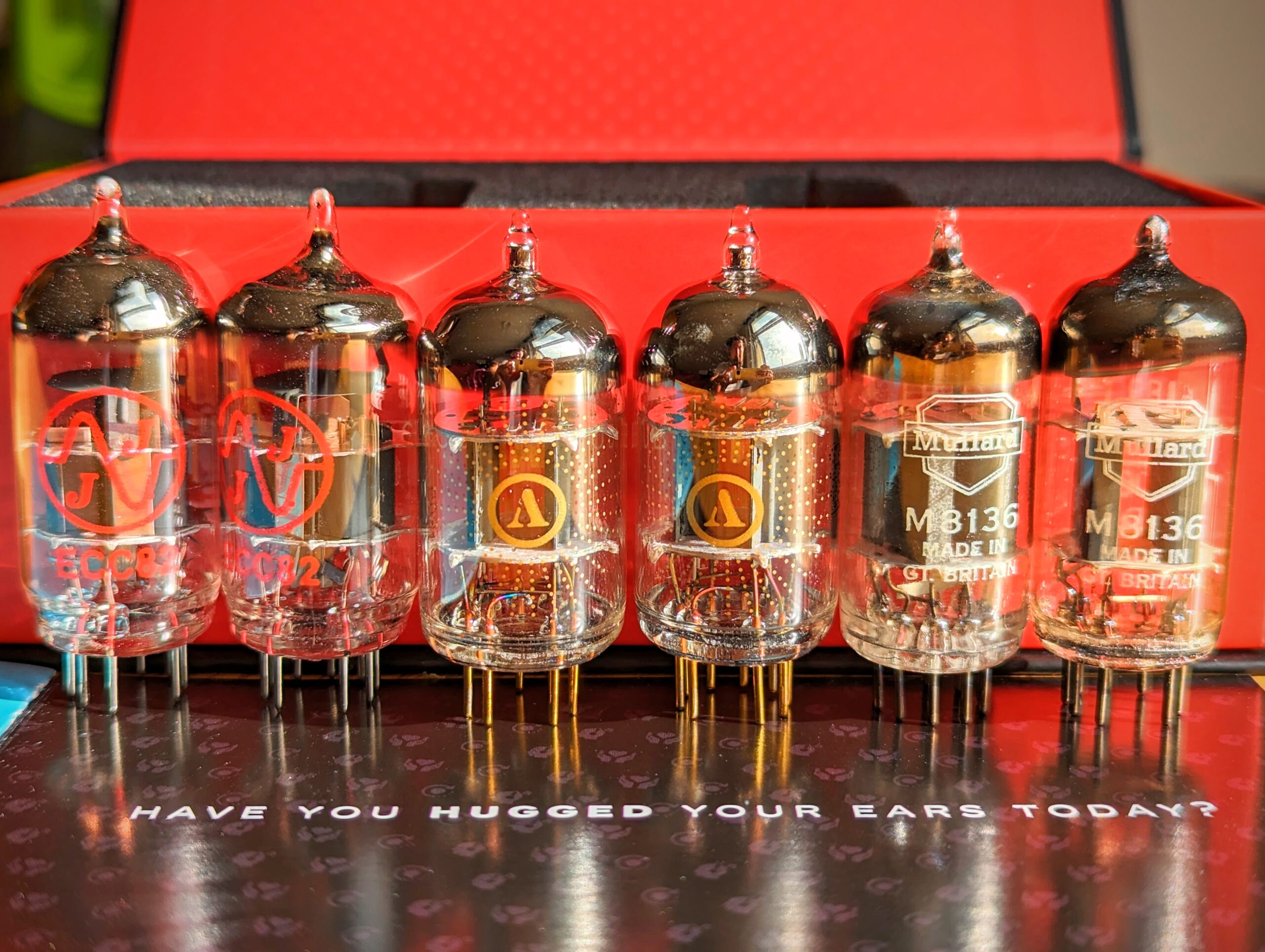
These are new production tubes made in Slovakia, a matched pair retails around $40-$50 and they were also the stock tubes in my Cayin HA-3A. These are good quality and reliable tubes, but do not sound the most interesting. In comparison to all other 12AU7s I will mention here, these sound a little lifeless, a little flat with lesser depth, but the most painful part is a relatively rolled off and not very energetic bass performance. To my experience a rolled off and weaker bass is the biggest challenge to most 12AU7 tubes, regardless of whether they are new or old production.
RCA Black Plates:
These were one of the first NOS matched pair tubes I bought for around $80. I enjoyed the more natural, more coherent sound compared to the JJs. These also sounded a bit more spacious, but I had similar issues with the bass performance. The lowest frequencies did not have the body and impact I am after.
Mullard M8136 CV4003 (old and new logo):
The old logo versions of these are my favourite 12AU7s to date. The new logo Mullards are nice too with a lot of warmth and a very engaging, euphonic sound, but the old versions offer more clarity and definition while keeping the same excellent tonality and timbre. The new logo versions (~after 1970) are around $220, the old logo Mullards are around $300 (~pre 1970).
Both versions of the Mullards are more expensive than the Apos Rays, and to my ears this is reflected in their sound too, especially when it comes to the old logo M8136. Compared to the Apos Rays these legends sound a little smoother, a little more coherent and refined. The Apos tubes hold up very well though, for $180 they offer pretty much 80% of what these Mullards are capable of. On these military spec (better reliability) NOS tubes music still sounds a little more natural to me, sub-bass is still a little more present, and it feels as if there was more control and grip in general.

Conclusion:
Where do I put the Apos Ray 12AU7s then on today’s tube market map? I think they are excellent sounding 12AU7s and by far the best sounding new production tubes I have ever heard. They are able to compete with some ‘new old stock’ tubes, even sounding better than many of them. The Ray 12AU7s offer a very exciting, clear yet colourful and engaging sonic experience. They only start to fall a little short when we compare them directly to the most regarded NOS 12AU7s which are also significantly more expensive. If you also take reliability (dead silent, noise free) and the three months warranty into account, we might just be witnessing the birth of a winner! Apos Audio’s first tubes sound great, they offer very good value, and their future plans are inspiring! What not to love?